Puppy Care · Updated 2026-11-17
Dog Years to Human Years: Chart by Age and Breed Size
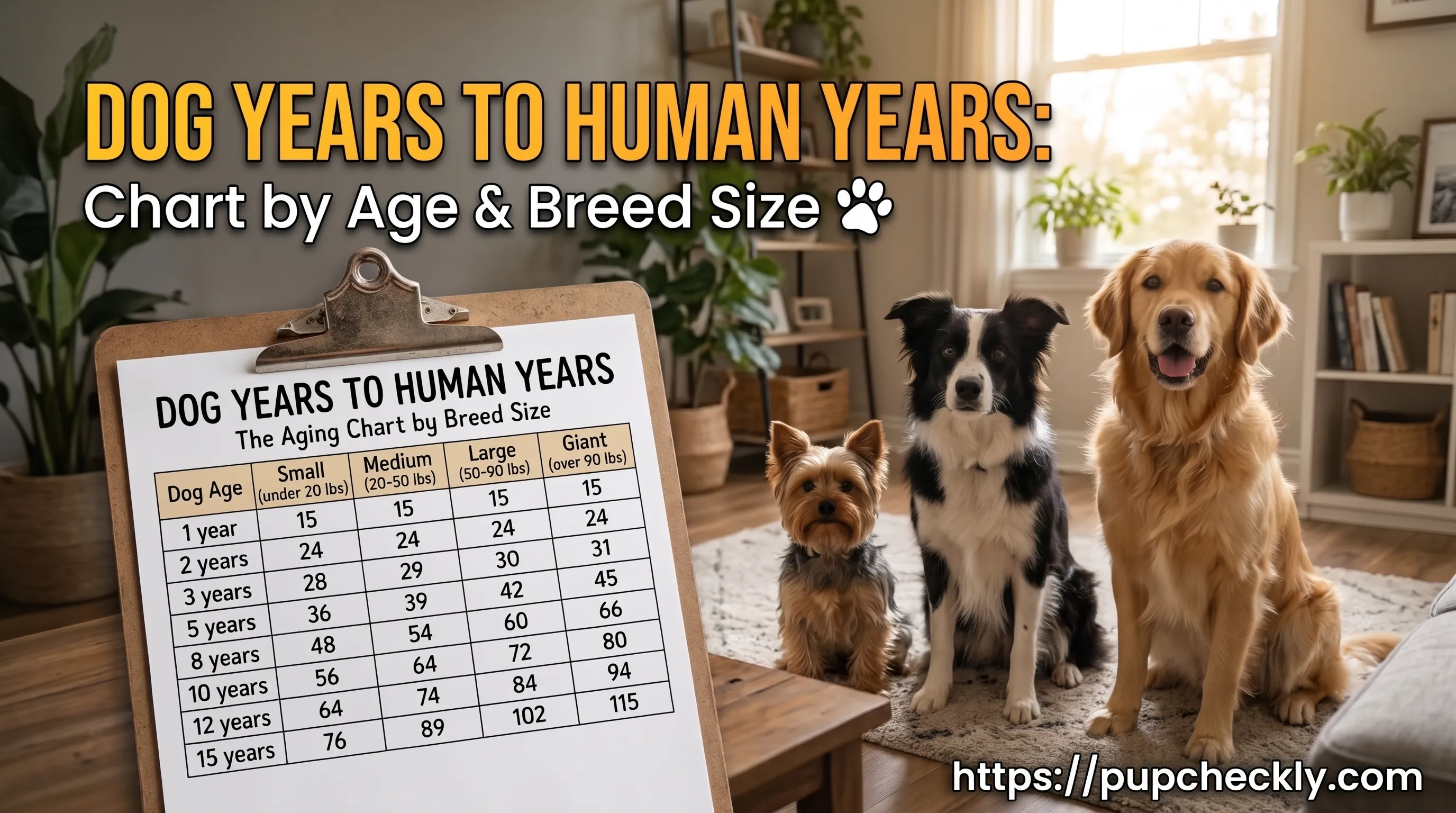
The old rule that one dog year equals seven human years is a myth. Dogs age quickly in their first two years and more slowly after that, and bigger dogs age faster than smaller ones. A medium-sized dog's first year is about 15 human years, the second about 9 more, and each year after that about 5. Find your dog in the charts below.
Key takeaways
- "Multiply by 7" has been popular since the 1950s, but it does not match how dogs actually age.
- The AVMA guideline for a medium dog: year 1 is about 15 human years, year 2 about 9, then about 5 per year.
- Size matters: large and giant dogs reach their senior years earlier than small dogs.
- A newer DNA-based formula gives a different answer for older dogs. Neither method is exact, so treat all of these as estimates.
- Use the number as a guide to life stage and ask your vet what care your dog needs at their age.
Last reviewed: November 2026.
Why "1 dog year = 7 human years" is wrong
Since the 1950s, the popular rule has been that one dog year equals seven human years. It is easy to remember, but it treats a one-year-old dog like a seven-year-old child, which does not fit how quickly dogs mature. Dogs mature very fast in their first two years, then age more slowly. The American Veterinary Medical Association (AVMA) says plainly that dogs do not age at seven human years per year.
Size also changes the picture. Smaller dogs tend to live longer and age more slowly, while large and giant breeds age faster in later life. That is why the better charts split dogs into small, medium, large and giant groups.
The AVMA rule of thumb (medium-sized dogs)
For a medium-sized dog, the AVMA guideline is simple:
- Year 1: about 15 human years
- Year 2: about 9 more human years (so about 24 at age 2)
- Every year after that: about 5 human years
So a 5-year-old medium dog works out to roughly 37 in human years, and a 10-year-old to roughly 60.
Dog years to human years chart by breed size
This chart shows the human-year equivalent by size, based on the widely published American Animal Hospital Association (AAHA) breed-size figures. Small is 20 lb (9 kg) or less, medium is 21 to 50 lb (10 to 23 kg), large is 51 to 90 lb (23 to 41 kg), and giant is over 90 lb (41 kg).
| Dog's age | Small (up to 20 lb / 9 kg) | Medium (21-50 lb / 10-23 kg) | Large (51-90 lb / 23-41 kg) | Giant (90+ lb / 41+ kg) |
|---|---|---|---|---|
| 1 year | 15 | 15 | 15 | 15 |
| 2 years | 24 | 24 | 24 | 24 |
| 3 years | 28 | 28 | 30 | 32 |
| 4 years | 32 | 33 | 35 | 37 |
| 5 years | 36 | 37 | 40 | 42 |
| 6 years | 40 | 42 | 45 | 49 |
| 7 years | 44 | 47 | 50 | 56 |
| 8 years | 48 | 51 | 55 | 64 |
| 10 years | 56 | 60 | 66 | 78 |
| 12 years | 64 | 69 | 77 | 93 |
| 14 years | 72 | 78 | 88 | 108 |
| 16 years | 80 | 87 | 99 | 123 |
Giant breeds usually do not live as long as the bottom rows suggest. For example, the Great Dane Club of America puts the average Great Dane lifespan at about 7 to 10 years. The chart is a way to compare life stages, not a prediction of lifespan.
Not sure which group your dog fits? Check the size and weight on your dog's breed page, for instance a Chihuahua (small), a Labrador Retriever (large) or a Great Dane (giant). For a puppy, use the expected adult weight.
The newer science: the DNA-based formula
In 2019, researchers at the University of California San Diego compared chemical changes in the DNA of 104 Labrador Retrievers aged from puppies to 16 years old with changes in human DNA over a lifetime. They produced this formula:
human age = 16 × ln(dog age) + 31 (where "ln" is the natural logarithm)
It gives results like these. The formula is meant for dogs over one year old, and I have rounded the results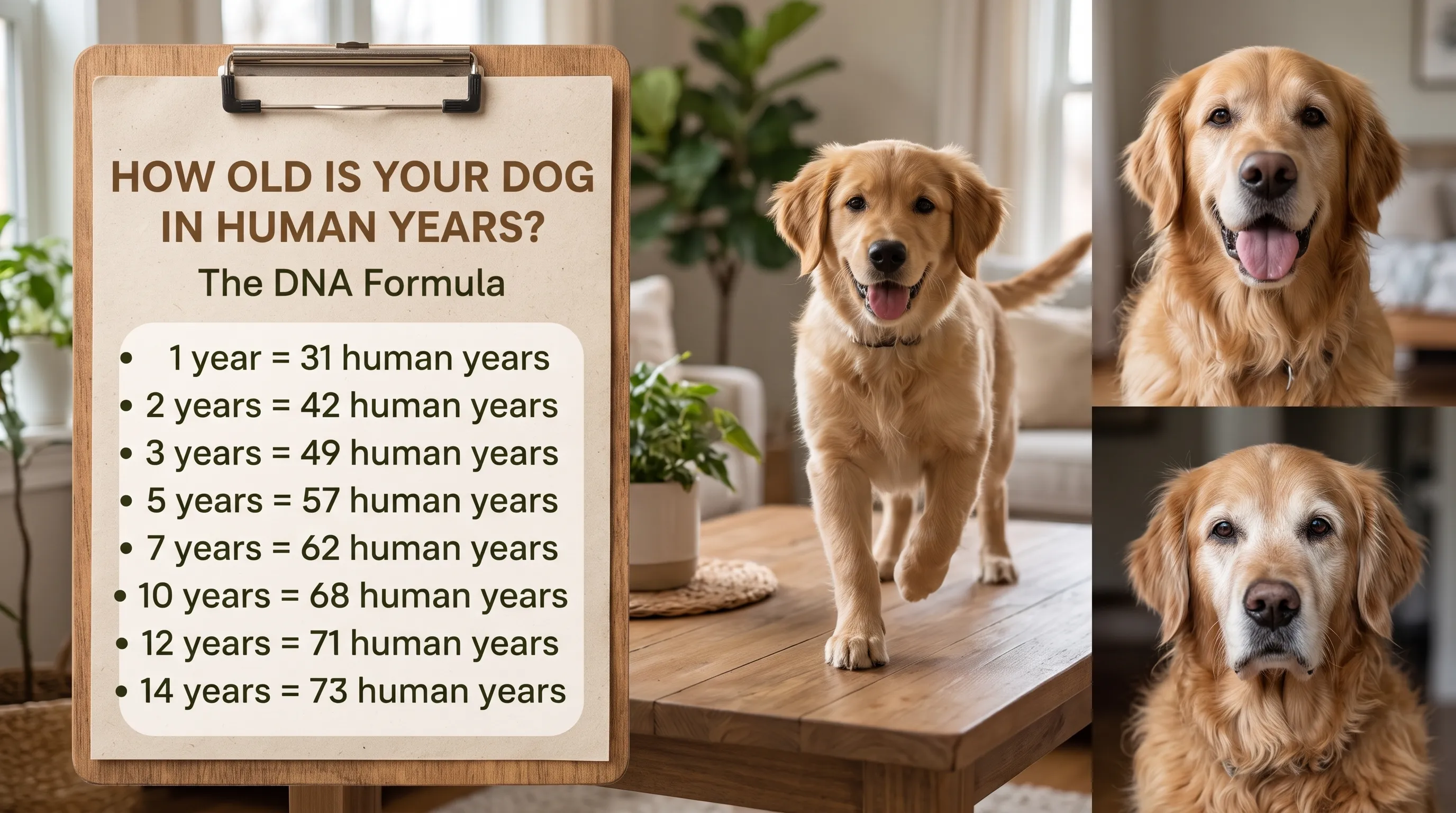
Notice how different this is from the AVMA and AAHA numbers: a 1-year-old dog is about 31 here but 15 in the vet charts. That is because the two methods measure different things. The DNA formula compares biological age markers, while the vet charts are designed around life stages and size. The DNA study also looked at only one breed, so it may not fit every dog, and it does not take size into account. Many sources suggest using it mainly as a general comparison.
A worked example
Say you have a 6-year-old Labrador (a large dog). Here is how each method sees your dog:
- "Times seven" myth: 6 × 7 = 42 (too low)
- AAHA large-breed chart: about 45
- DNA formula: about 60
All three disagree, which is the point: there is no single perfect number. What the charts do agree on is that a 6-year-old large dog is well into middle age and may need earlier health checks than a 6-year-old small dog.
What about puppies?
Puppies grow faster than at any other stage of a dog's life. By the DNA-based comparison, an 8-week-old puppy is roughly like a 9-month-old human baby. Our Puppy Milestone Tracker turns your puppy's birthday into a printable schedule of milestones, and the Puppy Weight & Growth Tracker helps you see how they are growing.
When does a dog become a senior?
There is no single age. Larger dogs are usually considered senior earlier than smaller ones. Sources vary: the AKC notes that large breeds are often seen as senior at about 5 to 6 years and small dogs at about 7, while other veterinary references put small breeds at 10 years or more. The AAHA's guidelines say that a dog's life stage should be defined by their age and breed characteristics, not just by a single number. Ask your vet when to start senior check-ups for your dog.
What are a dog's life stages?
- Puppy: from birth until rapid growth stops. Small and medium dogs are usually fully grown at about 6 to 12 months, while larger dogs take longer.
- Adult: full-grown and in their prime, with regular check-ups and a steady routine.
- Senior: a slower pace, more frequent vet visits, and changes to food, exercise and comfort.
The exact ages vary by breed and by dog. If you want a quick estimate for your own dog, try our free dog age calculator.
Which chart should I use?
- Quick estimate for any dog: the AVMA rule of thumb (15, then 9, then 5 per year).
- Better match for your dog's size: the breed-size chart above.
- Curious about biological age: the DNA-based formula, keeping in mind its limits.
Whichever you use, the most important thing is what the number tells you: how much exercise, which food and how often to see the vet. For medical decisions, always ask your own vet.
Where this information comes from
For the AVMA guideline and the DNA formula, see the American Kennel Club's article How to Calculate Dog Years to Human Years. For how vets define life stages, see the AAHA Canine Life Stage Guidelines.
This article is for general information only and is not veterinary advice. Every dog is different, so please follow your own vet's guidance.