Feeding · Updated 2026-11-21
How Much Should You Feed a Puppy? Feeding Chart by Age and Weight
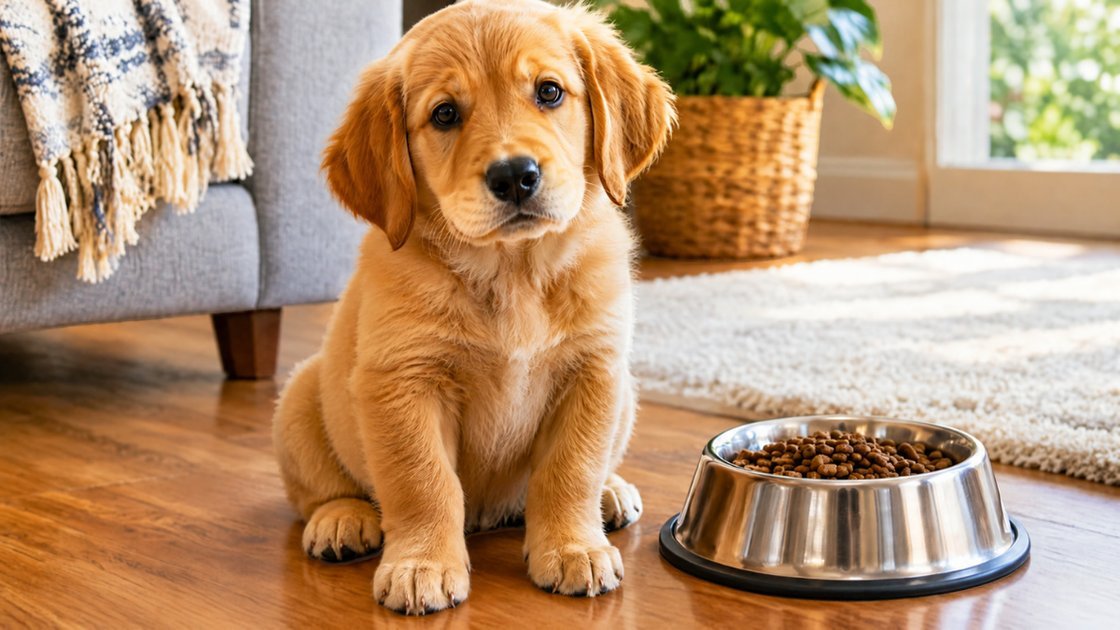
Quick answer: The most reliable way to decide how much to feed a puppy is to start with the feeding guide printed on your puppy's food, then check it against a daily calorie estimate and your puppy's body shape. Every food has a different calorie content, so a generic "cups per day" number can be wrong for your puppy. Weigh your puppy regularly and adjust as they grow.
Key takeaways
- Puppies need more calories per pound or kilogram than adult dogs because they are growing fast.
- Veterinary references give a starting estimate of about 3 × resting energy for puppies under 4 months and 2 × resting energy from 4 months on. This is only a starting point.
- Always convert calories into food using the calories-per-cup (or per kilogram) printed on your food. Weighing food in grams is more accurate than using a cup.
- Treats should stay under about 10% of daily calories, so reduce meals a little when you do a lot of training.
- Weigh your puppy every 1 to 2 weeks and judge body shape: ribs easy to feel but not see, and a visible waist from above.
How much food does a puppy need?
A puppy's food need depends on their current weight, age, breed size, activity and the exact food you use. Vets often start from a puppy's resting energy requirement (RER), the calories a dog needs just to stay alive at rest. The usual formula is RER = 70 × (body weight in kg)0.75 (PetMD). The Merck Veterinary Manual then lists a multiplier for healthy puppies: 3 × RER under 4 months old and 2 × RER over 4 months old. The same table reminds readers that any calorie calculation is only a starting point and may need adjusting based on how the dog responds.
You do not need to do this maths by hand. The chart below does it for you, and our free puppy feeding calculator can estimate it for your own puppy.
Puppy feeding chart by weight (daily calories)
These are estimated total calories per day for a healthy puppy, based on the current weight and the two multipliers above. They are rounded to the nearest 10 calories. Split the daily total across all meals.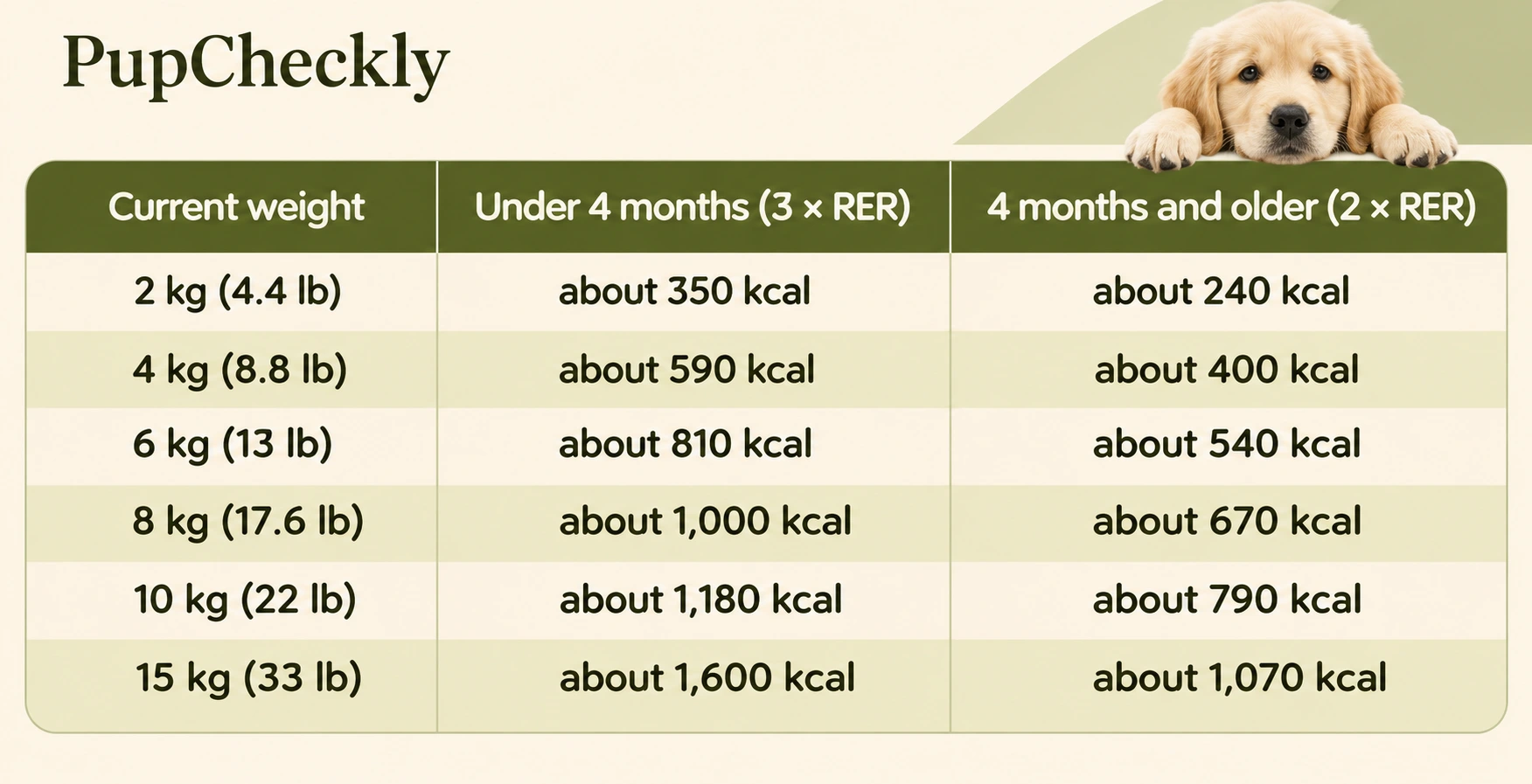
How to turn calories into food: find the calories on your food's label (listed as kcal per cup, per can or per kilogram) and divide. For example, a 600 kcal day on a food with 400 kcal per cup is 1½ cups. Calories per cup vary a lot between foods, which is why the bag's own number matters more than any generic chart.
Important: this is an estimate for a typical healthy puppy, not a prescription. Fast-growing, large-breed puppies are usually kept lean on purpose, so use the bag's guide and ask your vet before feeding a big puppy at the top of any range.
Worked example: a 10-week-old puppy
Say your puppy is 10 weeks old and weighs 4.5 kg (10 lb).
- Resting energy: 70 × 4.50.75 ≈ 216 kcal.
- Puppy under 4 months: 216 × 3 ≈ 650 kcal per day as a starting estimate.
- Treat budget: 10% of 650 is about 65 kcal. If you plan to use that much for training treats, meals should provide about 585 kcal.
- Convert to food: suppose the bag says 400 kcal per cup (an example only, check your own bag). 585 ÷ 400 ≈ 1½ cups a day.
- Split into meals: four meals is about ⅜ cup each. Weigh the portion in grams if you can.
Now compare this with the feeding guide on the bag for your puppy's current weight. If the two differ a lot, start with the bag, watch your puppy's weight and body shape for a week or two, and ask your vet which number suits your puppy.
How many meals a day should a puppy eat?
Puppies have small stomachs and burn energy quickly, so smaller, more frequent meals work better than one or two big ones. Merck notes that puppies need several meals a day when young, and the number drops as they age (Merck Veterinary Manual). A common pattern:
| Age | Meals per day |
|---|---|
| 8 to 12 weeks | 3 to 4 |
| 3 to 6 months | 3 |
| 6 to 12 months | 2 (the AKC suggests twice daily from 6 months) |
Keep mealtimes at about the same times each day. A predictable routine also helps house training, because puppies often need to go outside soon after eating. Our potty training checklist shows how to time this. Scheduled meals are also better than leaving food out all day, because you can see how much your puppy really eats and notice a skipped meal early.
How to read the feeding guide on the bag
- Check whether it is per day or per meal. Mixing these up is a common cause of overfeeding.
- Use today's weight and age. Update the amount as your puppy grows. Many bags list amounts by current weight, and some by expected adult weight as well.
- Remember treats count. Treats and chews add calories on top of meals. Treats should stay under about 10% of daily calories (see the AKC guide to the 10% rule), so cut meals slightly on heavy training days.
- Know your food's calories. Two foods can list very different cups for the same puppy because their calorie density differs.
Large-breed puppies need extra care
Large and giant-breed puppies grow for longer, and too much calcium or too many calories can affect healthy bone growth. AAFCO defines large-breed growth foods for dogs expected to weigh 70 lb (32 kg) or more as adults, but many vets use a more cautious cut-off of around 50 lb (23 kg) (VCA Animal Hospitals). If your puppy may reach that size, ask your vet about a food labelled for large-breed growth and keep portions measured, rather than feeding extra regular puppy food.
Wet food, dry food and mixed feeding
Dry, wet and mixed feeding can all work, as long as the food is labelled complete and balanced for growth or for all life stages (AAFCO in the USA, FEDIAF guidance in the UK and EU). Wet food has more water, so a portion looks larger than the same calories in kibble. Follow the can's own guide rather than swapping cup for cup. When you mix wet and dry, add up the calories from both so you do not accidentally double the portion.
How to switch puppy food safely
If you change brands or move to the next formula, switch slowly over 7 to 10 days to avoid an upset stomach. One common plan, similar to the one used by Purina: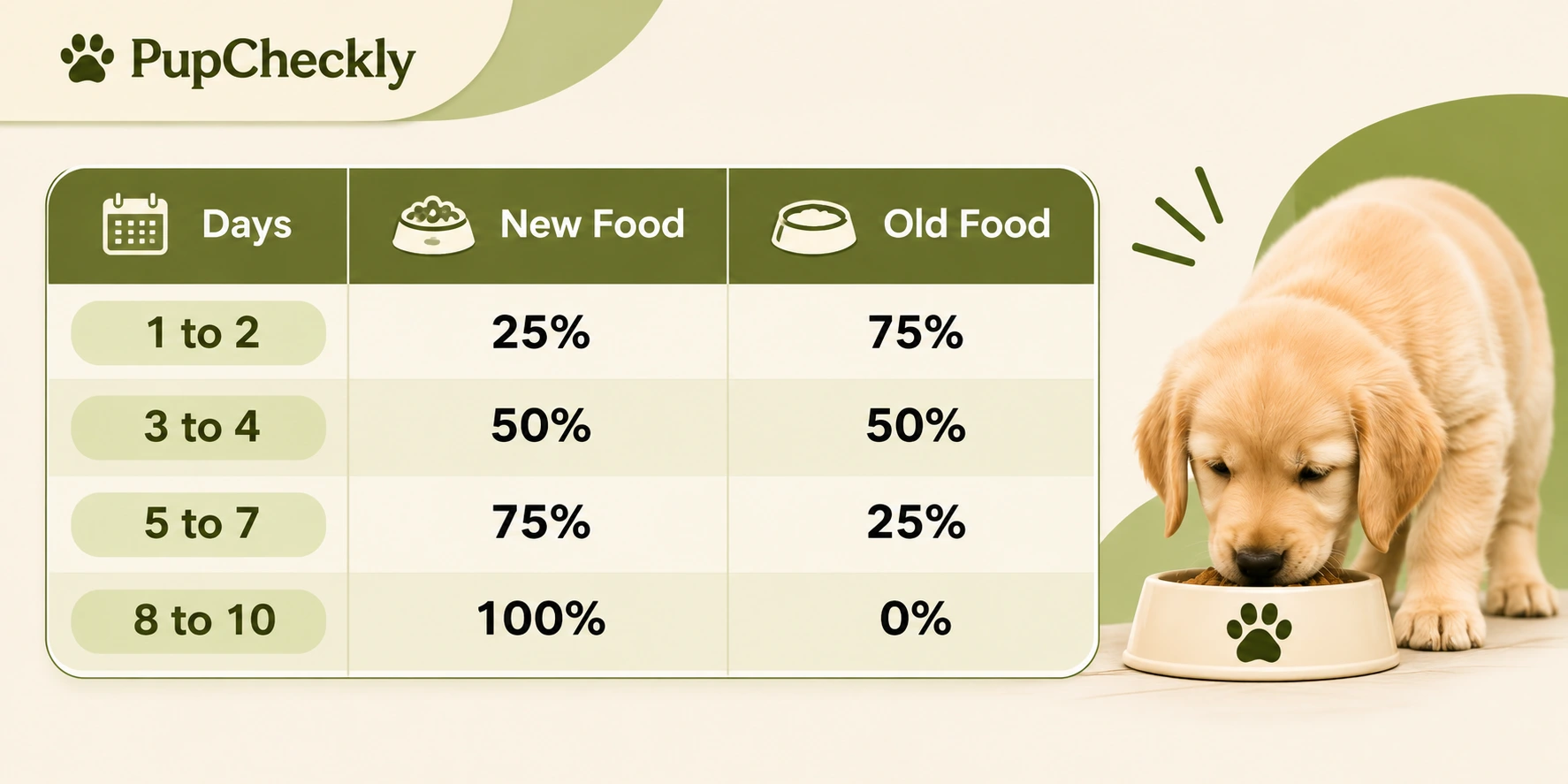
If your puppy gets loose stools, vomits or refuses food, go back a step and slow down. If it does not settle within a day or two, call your vet.
Signs you are feeding too much or too little
- Too much: you cannot easily feel the ribs, there is no visible waist from above, stools are often loose, or weight is climbing faster than your vet expects.
- Too little: ribs, spine or hip bones are very easy to see, your puppy seems low on energy, or weight gain is slow.
- About right: ribs are easy to feel with light pressure but not visible, you can see a waist from above, and weight rises steadily.
As the AKC puts it, watch the dog, not the dish: body shape tells you more than any chart. Track weight with our free puppy weight and growth tracker and take the chart to vet visits. You can also print the puppy feeding schedule checklist to log meals.
Common feeding mistakes
- Guessing portions by eye. Use a scale or a proper measuring cup.
- Not updating the amount as your puppy grows. Re-check every week or two.
- Switching to adult food too early. Adult food is not formulated for growth. Ask your vet when to switch.
- Forgetting treats and scraps. They add up quickly in a small body.
- Changing food too fast. Sudden changes are a common cause of tummy upset.
What if my puppy skips a meal?
A puppy who skips one meal but is playful, drinking normally and passing normal stools is usually fine. Try again at the next scheduled meal instead of free-feeding to tempt them. If your puppy is very young or a toy breed, do not wait long, because small puppies can become unwell quickly: call your vet. For any puppy, contact your vet the same day if they refuse food for more than 24 hours or show vomiting, diarrhea, lethargy or a swollen belly alongside the loss of appetite.
For more detail, the AKC puppy feeding fundamentals and the Merck Veterinary Manual puppy care page are good independent sources.
Last reviewed: 21 November 2026. This article is general information, not veterinary advice. Your vet can set a feeding plan for your puppy's breed, age, health and food.