Puppy Care · Updated 2026-11-20
When Can Puppies Go Outside? A Vaccine Timeline by Country
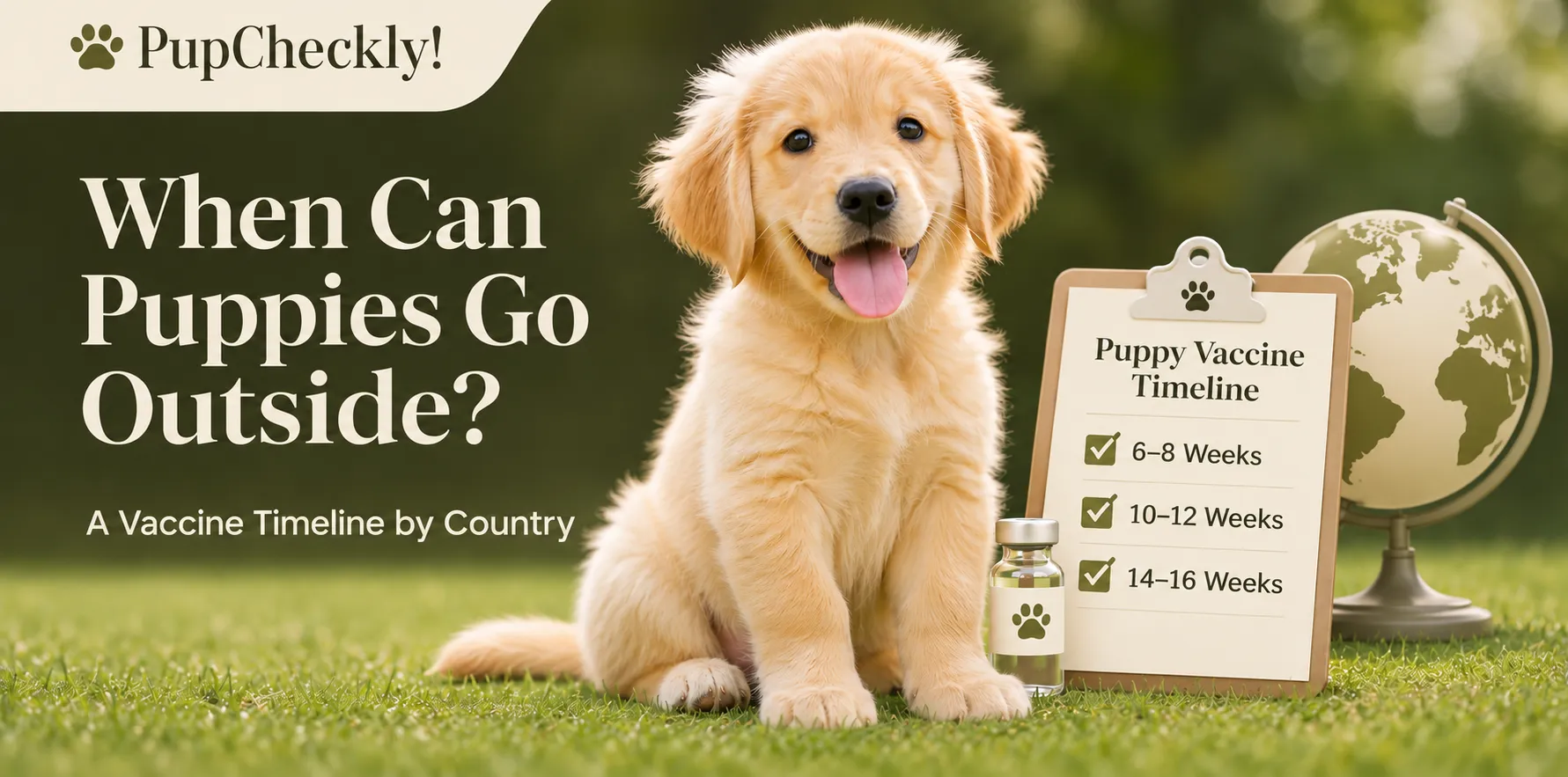
Most puppies can go to public places about two weeks after their final puppy vaccine. When that falls depends on your country and your vet's schedule: often around 12 to 14 weeks in the UK, and about 18 weeks or later in the US, Canada and Australia. Until then, your own safe garden, carried outings and clinic-run puppy classes can fill the gap. Always confirm the date with your vet.
Key takeaways
- Puppies are not fully protected after their first vaccine. Protection builds over a series of doses, so the "safe to go anywhere" date is after the last dose, not the first.
- The usual rule is to wait about two weeks after the final puppy vaccine before dog parks, beaches, pet store floors and busy sidewalks. Some vets say one to two weeks, and yours may say longer.
- Waiting does not mean locking your puppy indoors. The key early learning window for socialization runs until about 3 to 4 months of age, and there are plenty of safe ways to use it.
- Vaccine timing, rabies rules and regional vaccines differ by country and even by clinic, so use this guide to plan and your vet to decide.
- If your puppy seems unwell after being out, call your vet the same day.
Last reviewed: November 2026.
When can a puppy go outside for the first time?
It helps to split "outside" into two things. Your own safe, enclosed garden or yard is low risk, and many vets are happy for a new puppy to use it for toilet training and gentle exploring once they have settled in, as long as no unvaccinated or unknown dogs have been there. Public places where many dogs have walked, such as sidewalks, parks, beaches and pet store floors, are higher risk and should wait until your vet says your puppy is protected.
That second date is the one most owners ask about. Veterinary sources commonly describe it as about two weeks after the final dose of the puppy vaccine series. The exact timing depends on when your puppy's series ends, which is why the answer is a range and not one number.
Why can't puppies go everywhere straight away?
Puppies are born with some protection from their mother, but that protection fades over the first few weeks and it can also interfere with a vaccine working. That is why puppies need several doses a few weeks apart instead of one. The American Animal Hospital Association (AAHA) guidelines recommend at least three doses of the core combination vaccine between 6 and 16 weeks of age, spaced 2 to 4 weeks apart. See the AAHA vaccination recommendations for the details your vet works from.
The diseases these vaccines protect against, such as parvovirus and distemper, can be very serious and sometimes fatal in young puppies. There is no cure for parvovirus, so treatment is supportive care from a vet, which is why prevention matters so much. You can print our puppy vaccination schedule checklist to keep your puppy's dates in one place.
Which places are safe before your puppy is fully vaccinated?
This table is a general guide. Your vet knows your area's disease risk and can adjust it.
| Place or activity | Before the series is finished |
|---|---|
| Your own enclosed garden or yard | Usually fine, if no unvaccinated or unknown dogs use it. Good for toilet training. |
| Being carried in public (for example in your arms or a sling) | Usually fine. Keep your puppy off the ground and away from other dogs. |
| A friend's home with a healthy, fully vaccinated dog | Often fine for a calm, supervised meeting. Ask your vet. |
| Puppy classes run by a vet clinic or a trainer who checks vaccine records | Often allowed after the first vaccine (see below). Ask your vet and the trainer. |
| Quiet, clean pavement where dogs rarely go | Vet dependent. Some vets allow it, others wait. |
| Dog parks, beaches, busy sidewalks, pet store floors, shared grass | Wait until your vet says your puppy is protected. |
What can my puppy do at 8, 12 and 16 weeks?
Use this as a rough map for a typical vaccine course. Your puppy's own dates may be earlier or later.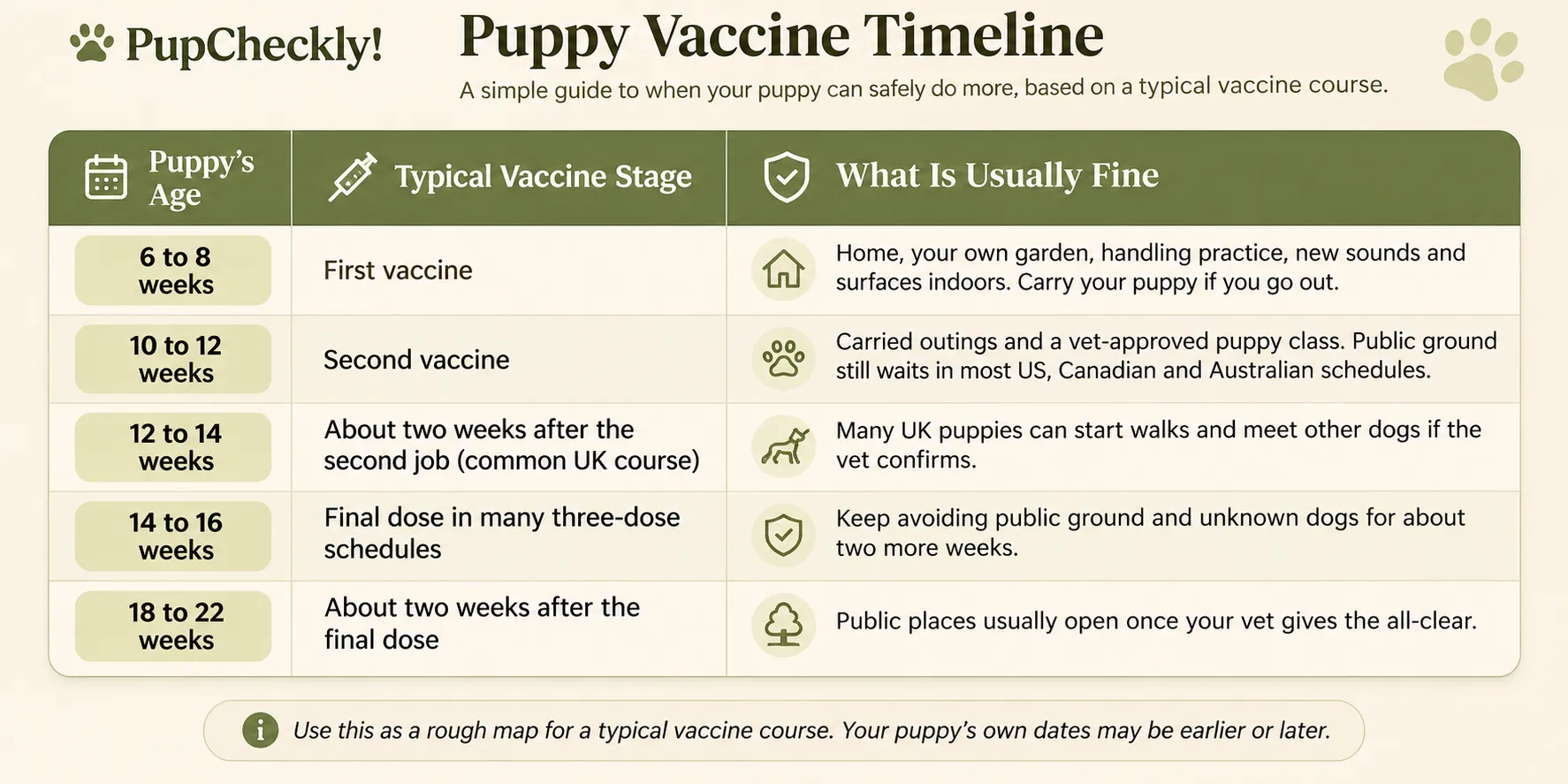
When can puppies go outside in the US?
In the US, many vets follow the AAHA pattern: at least three doses of the core vaccine between 6 and 16 weeks, 2 to 4 weeks apart. Rabies is usually given once at around 12 to 16 weeks, depending on your state or local rules. Because the last dose often falls at about 16 weeks, public places commonly open at around 18 weeks. PetMD describes it as two weeks after the final vaccine, which it gives as typically 18 to 22 weeks of age, depending on the schedule. Some regions also recommend leptospirosis or Lyme vaccines, so ask your vet which apply where you live.
When can puppies go outside in the UK?
In the UK, the primary course is often two injections a few weeks apart. Medivet lists the first dose at 6 to 8 weeks and the second 2 to 4 weeks later, usually at 10 to 12 weeks, with a third dose at 14 to 16 weeks for some puppies depending on the vet's assessment. Rabies is not part of the routine puppy course in the UK, though you may need it for travel abroad. Medivet says most puppies can walk and meet other dogs about two weeks after the second vaccination, typically around 12 to 14 weeks, and that your vet should confirm the timing. If your vet adds a third dose, wait until after it.
When can puppies go outside in Canada?
Canadian vets generally recommend the same core vaccines as the US: distemper, infectious canine hepatitis, parvovirus and rabies. The Canadian Veterinary Medical Association (CVMA) says rabies vaccination is mandatory in some higher-risk parts of Canada, so ask your vet about your local rules. The same page notes that puppies typically finish their vaccine series by about six months of age, so your clinic's schedule may run later than the 16-week pattern. As elsewhere, the safe date for public places is usually about two weeks after the final dose, so around 18 weeks for a puppy whose last dose is at 16 weeks, and later if the series runs longer. Your vet will confirm it for your province.
When can puppies go outside in Australia?
Pet Circle describes a course of three injections about four weeks apart, usually at around 6 to 8 weeks, 12 to 14 weeks and 16 to 18 weeks, though timing varies by location and vet protocol. Its vet guide advises that, unless your vet says otherwise, you should avoid dog parks, beaches and other dog hotspots until two weeks after the final vaccination. Before then, puppies can go to public places if they are carried. That usually means public ground opens at around 18 to 20 weeks. Ask your vet about puppy preschool for puppies that have had their early vaccines.
A worked example: when would public places open?
Here is roughly when public places could open on three example patterns, counting about two weeks after the final dose. These are examples only.
| Pattern | Final dose at | Public places from about |
|---|---|---|
| Two injections, as in a common UK course (for example at 8 and 12 weeks) | 12 weeks | 14 weeks |
| Three doses, final at 16 weeks (common in the US) | 16 weeks | 18 weeks |
| Three doses, final at 18 weeks (a later schedule, seen in some Australian clinics) | 18 weeks | 20 weeks |
The point is not that one country is safer. Vaccine products, schedules and local disease risk differ, so your vet will choose the plan and tell you the date. Put your puppy's dates into our puppy milestone tracker to see them on a calendar.
Should I wait to socialize my puppy until they are fully vaccinated?
Not completely. The American Veterinary Society of Animal Behavior (AVSAB) encourages vets to recommend that puppies are socialized before the vaccine series is complete, and says the period from adoption until about 3 to 4 months of age is critical for meeting people, animals and new places. It says puppies can start socialization classes as early as 7 to 8 weeks, with at least one set of vaccines at least 7 days before the first class and a first deworming. You can read the AVMA's coverage of the AVSAB position. Disease risk still matters, so choose clean, supervised settings, such as classes run by a vet clinic, and always ask your vet first.
How can I socialize my puppy safely before they can go out?
- Carry them out. Sit on a bench or in a cafe patio with your puppy on your lap, so they can watch traffic, people and bikes without touching the ground.
- Use your garden. Let your puppy explore different surfaces (grass, paving, a mat) as long as the space is safe and not visited by unvaccinated dogs.
- Bring the world home. Play recordings of everyday sounds quietly, introduce vacuum cleaners, umbrellas and hats at a distance with treats, and invite calm, friendly visitors.
- Short car rides. A few minutes in a secured crate or carrier, ending somewhere good (even just back home with a treat), helps avoid car sickness and fear later.
- Handling practice. Gently touch paws, ears and mouth, then reward, so vet visits and grooming are easier.
- Healthy, vaccinated adult dogs. A calm friend's dog in a clean, private space can be a good teacher. Ask your vet first.
Go slowly and keep every experience short and positive. Our puppy socialization checklist gives you a list of sights, sounds and surfaces to tick off, and our first week plan shows how to fit it into your puppy's routine.
What if my puppy missed a vaccine, or I am not sure of their history?
Do not guess. If a dose was late, you are missing paperwork or your puppy was adopted from a shelter or abroad, ask your vet how to proceed. They may adjust the schedule, and the date for going out may change with it.
What should I do if my puppy seems unwell after going out?
If your puppy shows vomiting, diarrhea, unusual tiredness or loss of appetite, call your vet the same day and mention where they have been. Do not wait to see if it passes, because young puppies can get sick quickly.
Where this information comes from
This guide draws on the AAHA's canine vaccination guidelines, PetMD, the AVSAB position on puppy socialization (via the AVMA), and the vet guidance linked above from Medivet (UK), the CVMA (Canada) and Pet Circle (Australia). Vaccine schedules are recommendations and not requirements, and your own vet's plan always comes first.
This article is for general information only and is not veterinary advice. Every puppy is different, and disease risk varies by region, so please follow your own vet's guidance.